Showing posts with label Semiotics. Show all posts

Thursday, August 7, 2008

Jean Baudrillard


Well heres another must read in the semiotics list, but again I believe its very interesting reading! Jean Baudrillard's Simulacra and Simulation (1994), which is translated by Sheila Faria Glaser, uses the semiotic thoeries of Pierce and Saussure but develps them further. He is especially interested in the way signs in our society now no longer relate to an actual reality but relate instead to themselves. He argues that this operation in our society leads to a hyper-reality. When looking at adverts or any communicating images its possible to see how these theories take shape within them. Especially in big corporate adverts... for instance the Halifax advert that features the company's employees singing 'we are sailing' and then the actual building takes sail out to sea with a lit X on the roof. Deconstructing such advertisments through semiotic analysis allows for a deeper under standing of the way in which meaning is communicated through design.

Marshall McLuhan


I would advice everyone also to have a look at McLuhans book Understanding Media: The Extension of Man, which he published in 1964. Even if your not a big fan of philosophical texts I think his beginning chapter The Medium Is The Message, is vitally relevant to todays market, especially when considering the range of ambient marketing. Its sound knowledge to have when dealing with the realm of Media.

Wednesday, July 30, 2008

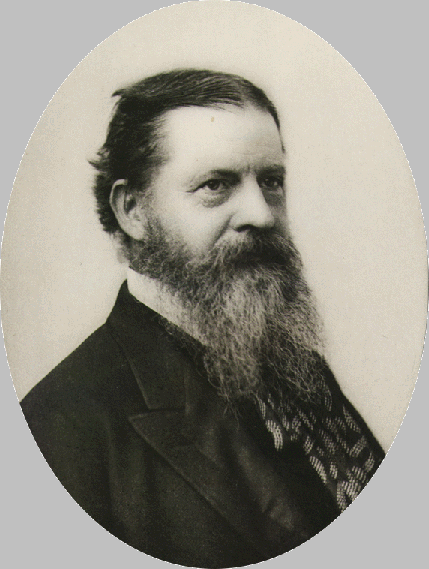
Charles Sanders Peirce


A rudimentary knowledge of semiotics is, in my opinion, necessary for anyone studying any form of communication. Semiotics is the study of signs or the theory of signification. It explores and describes the way in which meaning is created and understood. It’s a highly complex form of philosophical thought that is relatively new and widely disputed. Its acceptance into wider schools of thought is perhaps hindered by the complex form of language used to describe semiotics. C. S Peirce is considered to be the founding member of semiotics and I would suggest reading, Peirce on Signs: Writings on Semiotic, by James Hoopes (editor). His works are philosophical and it can be hard to follow in places, the language is particularly hard to understand, yet in spite of this I feel that it essential reading if you want to understand any further semiotic texts. Further readings are highly valuable when creating an understanding of the way in which people understand and consume graphic images. Although Ferdinand de Saussure is also considered a founding member of semiotics or semiology, his writings are more concerned with linguistics, and I would not recommend reading his texts. Barthes, Eco and Baudrillard are other authors on semiotics and whose theories are worth observing.